🎚️The Studio
Backing tracks (Play with the Band), capturing licks over MIDI, Changes, and the Toolbox — tuner, metronome, and audio health.
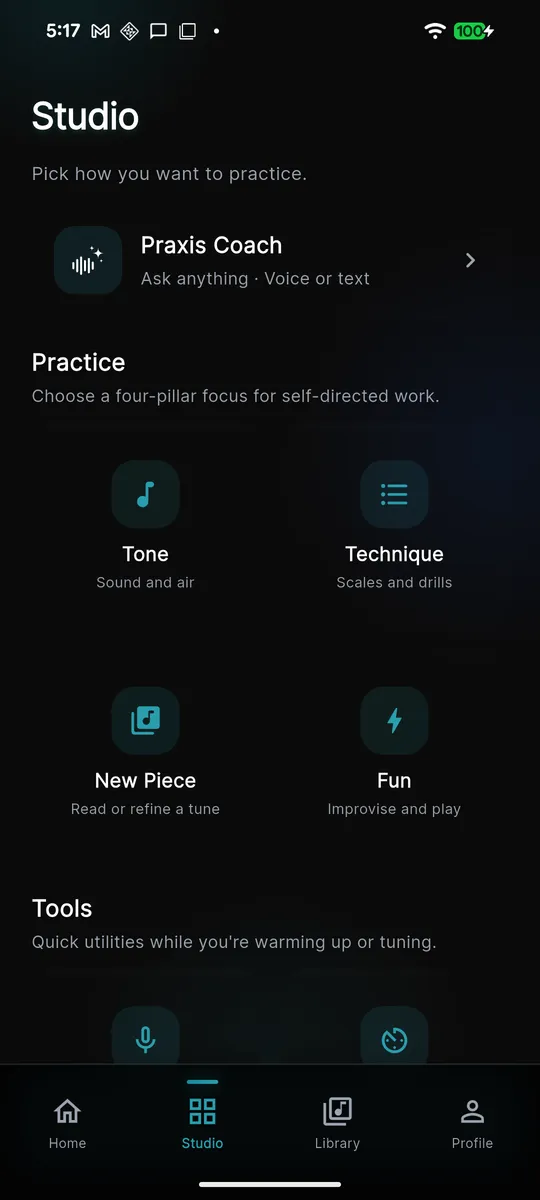
The Studio tab is your workshop for self-directed practice — everything you reach for when you're not following a guided lesson. It opens with the Praxis Coach pinned at the top, then groups the rest into four sections: Practice, Tools, Create, and Review. Tap any card to open that surface; tap the back arrow to return to the grid.
Practice — self-directed play
The Practice section is where you go to simply play without a fixed lesson. Instead of a single "solo play" button, it offers four focus areas so you can pick what to work on:
- Tone — sound and air.
- Technique — scales and drills.
- New Piece — read or refine a tune.
- Fun — improvise and play over what you've already earned.
To start: tap a focus card, then follow its setup screen (choose a scale, tune, or drill) and begin playing. Praxis listens through your mic and gives real-time pitch feedback.
Backing Track (Lyria) — play with a band
This is Praxis's "play with the band" surface. The Backing Track (Lyria) card generates a custom groove — a rhythm section you can solo over — using Google's Lyria music model.
- Open Backing Track (Lyria) from the Create section.
- Pick an ensemble (for example Rhythm Section (No Saxophone), Rhythm Section + Horn Section, Piano & Bass Duo, or Guitar, Bass & Drums Trio).
- Tap generate, wait for the track to render, then press play and start soloing over it.
Capture Lick (MIDI) — save your licks
The Capture Lick (MIDI) card records a lick you play and saves it perfectly. It is MIDI-only: you need a MIDI keyboard or wind controller connected, because Praxis transcribes the exact notes rather than guessing from audio.
- Connect your MIDI device (see the MIDI & Devices page).
- Open Capture Lick (MIDI), play your phrase, and stop recording.
- Review the captured notes, then save. Saved licks appear in your personal Licks library on the Library tab, where you can edit, replay, or export them.
Changes — comp chords to solo over
Changes loops a chord progression with a piano comping behind you, so you can practice improvising over the harmony. It shows the chords and suggested improvisation scales (guide tones), lets you set the tempo, and can cycle the progression through all twelve keys.
To start: open Changes from the Create section, pick a preset, and tap play. If the piano transport is greyed out, playback isn't available on your device yet — the chords and guide tones still display so you can read along.
The Toolbox — tuner, metronome, and setup checks
The Tools section holds the quick utilities you reach for while warming up. Each opens as its own screen:
- Tuner — tune by ear. Play a note and the display shows how sharp or flat you are. It reads your written pitch (what you finger), not concert pitch. While it's open the app-wide "Mic on" indicator stays lit.
- Metronome — keep time. Set a tempo, or use the Tap button to tap a beat and let Praxis match it, then start the click.
- Audio Health — check your pitch and setup. Run this if the app isn't hearing you correctly; it confirms your input source and that Praxis is detecting your sound cleanly.
The Review section rounds out the tab with Recent Sessions (what you practiced lately) and What Coach Remembers (the profile facts the Coach draws on).