🎹MIDI & Devices
USB and Bluetooth MIDI setup, transposition, and capturing licks over MIDI.
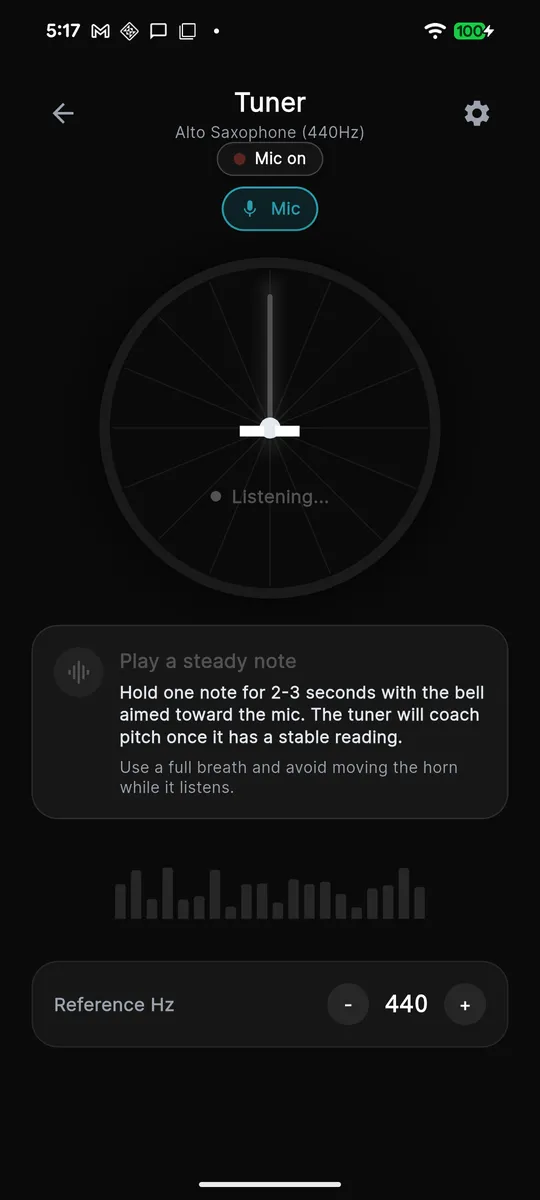
Praxis reads your playing from a connected MIDI instrument — a wind controller or a keyboard — over either USB or Bluetooth (BLE). Once a device is connected, every note you play feeds the tuner, the exercises, and the Praxis Coach, and unlocks MIDI Lick Capture for recording your own phrases.
Connect a USB MIDI device
A USB wind controller or keyboard connects through your phone or tablet's charging port.
- Plug the instrument into your device. On most phones you'll need a USB-C (or Lightning, on older iPhones) adapter — use one that carries data, not a charge-only cable.
- Open MIDI Setup (in onboarding, or later from Settings).
- Your instrument appears under Available Devices. Tap it to connect.
- Play a note — the Test Input panel lights up and shows the detected note.
Connect a Bluetooth (BLE) MIDI device
Wireless instruments and BLE-MIDI adapters connect without a cable.
- Turn the instrument on and put it in pairing mode (check its manual).
- Make sure Bluetooth is enabled on your phone or tablet.
- Open MIDI Setup. Praxis scans automatically; the device appears under Available Devices once it's discovered.
- Tap the device to connect, then play a note to confirm the Test Input panel responds.
Playing sounds through another app
Praxis listens to your MIDI notes for feedback but doesn't voice them itself. To hear a rich instrument sound, run a synth app such as GarageBand or Respiro alongside Praxis (enable its background-audio option). Praxis keeps giving feedback while the other app produces the sound. See the Sound Setup Guide link on the MIDI Setup screen.
Transposition: written vs. concert pitch
Saxophones are transposing instruments. The note you read on the page isn't the same pitch that comes out of the horn:
- On an Alto (E♭) sax, a written
Csounds as a concertE♭. - On a Tenor (B♭) sax, a written
Csounds as a concertB♭.
Praxis handles this for you. It knows which saxophone you play from your profile, so it shows notes in written pitch — what you'd read on your music — while tracking the actual concert pitch underneath. In the Test Input panel you'll see both: the written note you're reading, with the concert note shown below it.
MIDI Lick Capture
Lick Capture records a phrase you play and transcribes it into a personal lick you can save, review, and revisit in your Library. Because it reads MIDI note data directly, the transcription is note-perfect — exact pitches, rhythm, and timing.
Capture a lick
- Connect a MIDI device (Lick Capture requires one — see above).
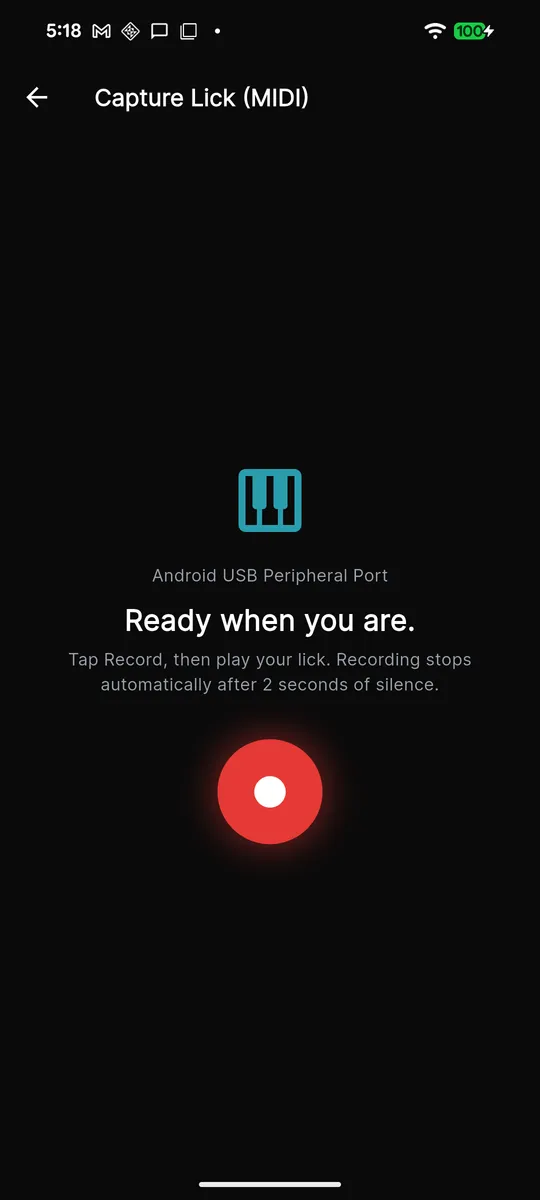
- Open MIDI Lick Capture in Studio. When a device is connected it shows Ready.
- Tap record and play your phrase.
- Stop playing. After a couple of seconds of silence, Praxis automatically ends the take and analyzes it — detecting the key and tempo.
- Review the transcription, adjust the title, key, or tempo if you like, then save it to your Library.
Why Lick Capture is MIDI-only
Lick Capture works only with a MIDI instrument — there is no microphone-based version, and that's deliberate. Perfect transcription depends on the exact note data that only MIDI delivers. Detecting pitch and rhythm from an acoustic microphone signal is never 100% reliable, so audio-based lick capture is intentionally not offered. If you want flawless transcription of your own phrases, play them in over MIDI.